Air Purifiers · A Practical Guide
Ionizer Claims vs. HEPA Ratings: What Air-Cleaner Labels Reveal
On an air-cleaner box, a phrase like “advanced ionization” can sound as decisive as a number beside “HEPA.” They are not equivalent kinds of information. One usually names a method; the other, when used precisely, describes a filter’s particle-capture performance. To compare devices, look past the most confident wording and ask what was measured, under what conditions, and what the machine actually does with the material it removes from the air.
Published November 17, 2026
Air-cleaner labels are small documents of persuasion. They offer a tidy answer to a messy question: what, exactly, is in the air around us, and what can a machine do about it? Dust and pollen are particles. A cooking smell is a mixture of gases and vapors. Smoke can include both. A device may reduce one class of pollutants while having little effect on another, yet packaging often compresses the distinction into a parade of reassuring terms: clean, medical-grade, ionic, all-natural, whole-room.
The reader’s task is not to decide whether a word sounds scientific. It is to find out what the word commits the manufacturer to. “Ionizer” generally describes a way of electrically charging particles. “HEPA” refers to a class of particle filter, though the exact claim and its test basis should still be checked. A room-size recommendation concerns how much air the device can process in a given space. An ozone-emissions statement addresses a separate question about a possible byproduct of certain electrical technologies.
These details belong together, but none substitutes for the others. A device can use an ionization feature and a mechanical filter. It can have an impressive filter specification and still be poorly matched to a room. It can capture particles without removing gases, or reduce certain odors without meeting a high particle-removal standard. A good label makes these boundaries visible. A vague one asks the buyer to supply the certainty.
What an ionizer does—and what the word does not say
An ionizer uses an electrical field or discharge to give airborne particles an electric charge. Charged particles may then collect on oppositely charged plates, settle on nearby surfaces, or clump together in ways that can make them easier to remove. The precise mechanism depends on the design. Some air cleaners use ionization as one component of a larger system; others make it a central feature.
That description tells you something about the approach, but it does not, by itself, tell you how well a particular appliance cleans a particular room. “Ionizer” is not a particle-removal percentage, a standardized room-cleaning rate, or a promise that every charged particle is captured inside the machine. If particles settle onto a wall, desk, or floor, they may have left the air without having been contained in a filter. They can be disturbed and become airborne again. The distinction between collecting contaminants and relocating them is worth keeping in view.
Ionization claims also do not automatically describe performance against gases, odors, or volatile organic compounds (VOCs). Those pollutants behave differently from particles. Some can be reduced by adsorption onto suitable media, such as activated carbon, but a statement about ion production alone does not establish that a device will remove them. Ask what pollutant is being discussed and what test supports the claim.
Labels may use neighboring terms—“plasma,” “bipolar ionization,” or “electrostatic”—for related but nonidentical technologies. The names can be useful clues, not conclusions. A responsible specification explains the mechanism clearly, identifies the measured outcome, and gives the conditions of testing. If the wording stops at “destroys pollutants” or “purifies every molecule,” the missing information is the point.
What a HEPA rating measures
HEPA is an acronym for high-efficiency particulate air. In ordinary consumer use, the term points to a mechanical filter designed to capture particles as air passes through it. A familiar benchmark in the United States is a filter efficiency of at least 99.97 percent for particles around 0.3 microns under specified test conditions. The exact standard, test method, and claim can vary by product and market, so a careful label or technical sheet should say what is being certified or tested.
The number is not a guarantee that an entire room’s air will instantly become 99.97 percent cleaner. It describes the filter’s performance under a defined test, not the complete performance of every assembled appliance in every home. Air may bypass a filter if the unit is poorly sealed. The fan may move too little air for the room. A filter may be dirty or incorrectly installed. And the number does not tell you whether the machine captures gases or odors.
There is a further wrinkle: “HEPA-type,” “HEPA-like,” and “HEPA-style” are not interchangeable with a clearly documented claim that a filter meets a named HEPA standard. Such phrases may be descriptive or promotional rather than evidence of a particular tested efficiency. When the wording is ambiguous, look for the test standard, the tested particle size, and whether the claim applies to the filter material alone or the complete unit.
A filter’s efficiency is only part of the story. Airflow matters. A highly efficient filter through which little air moves may clean a room less effectively over time than a well-designed system that combines adequate airflow with strong capture. The useful question is not simply, “How good is the filter?” It is, “How much suitably filtered air does this unit deliver in the space where I intend to use it?”
The room-size claim: a number with conditions
Room-size guidance turns performance into a practical decision, but it can be presented in ways that are difficult to compare. A square-foot figure is meaningful only alongside assumptions about ceiling height, air changes per hour, fan speed, and the test or calculation used. A large maximum coverage number may be based on a low air-change rate or a setting so noisy that few people will use it overnight.
For particle removal, a useful specification is the clean air delivery rate, or CADR, where available. CADR estimates the volume of clean air delivered for specified particle categories. In the United States, the Association of Home Appliance Manufacturers (AHAM) operates a voluntary certification program for certain room air cleaners. A certified rating can make comparisons more consistent, but readers should still check which pollutants the rating covers and whether the model and operating conditions match the claim on the label.
Room dimensions matter, too. A device described as suitable for a 300-square-foot room may be less effective in a room with a high ceiling, an open connection to another space, or a steady source of smoke or dust. Doors, windows, ventilation, and where the purifier sits all influence how air circulates. A purifier tucked behind furniture is unlikely to perform as intended, however elegant its specification sheet.
Noise and energy use are not afterthoughts. A unit’s highest fan setting may deliver the strongest airflow but be too loud for sleep or conversation. If the machine will usually run on a quieter setting, compare performance at that setting where data are available. The best purifier on paper is not especially useful if its daily sound or operating cost encourages its owner to switch it off.
Ozone emissions deserve their own line
Some electrical air-cleaning technologies can produce ozone, intentionally or as a byproduct. Ozone is a reactive gas; it is not simply “oxygen made stronger,” and its presence should not be treated as a neutral sign of purification. At concentrations relevant to indoor exposure, it can irritate the lungs. People with asthma or other respiratory sensitivities may be particularly concerned, and ozone can also react with substances indoors to form additional pollutants.
This does not mean that every appliance containing an electrical component emits ozone at a harmful level. It means the question deserves a measured answer rather than a slogan. Look for an emissions result, the testing method, and the conditions under which the device was assessed. A statement such as “ozone-free” is clearer when accompanied by a defined test or an applicable certification. If the manufacturer provides no emissions information for an ionizing product, consider that an unanswered question.
In the United States, the California Air Resources Board maintains an air-cleaner certification program that includes ozone-emission limits for covered devices sold in California. Certification or compliance can be useful evidence, but it does not settle every question about particle performance, room suitability, or emissions under every possible use condition. Check the scope of the certification and whether the particular model appears in the relevant listing.
Be wary of claims that treat ozone as a helpful indoor air ingredient. Ozone’s ability to react with some substances does not make it a prudent general-purpose way to clean occupied rooms. Follow product instructions, heed applicable public-health guidance, and do not infer safety from a machine’s “natural,” “fresh,” or “hospital” language. Those adjectives do not disclose an emissions measurement.
Particles, gases, and the limits of a single filter
Air pollution is not one thing, and no single specification describes a device’s performance against everything a person might want to remove. Mechanical filters are used to capture particles such as dust, pollen, and some smoke particles. Activated carbon and other sorbent media may reduce certain gases and odors, depending on the material, quantity, and contact time. A filter’s presence does not prove equal effectiveness for every contaminant in those broad categories.
Consider a product description that lists HEPA media and activated carbon. Those are useful construction details, but a reader still needs to know the test basis for the particle claim and the scope of the gas or odor claim. How much carbon is present? Which pollutants were tested? At what concentration and airflow? How long did the media remain effective under those conditions? Product literature often answers some of these questions and not others. Separating stated specifications from broader promises helps keep expectations realistic.
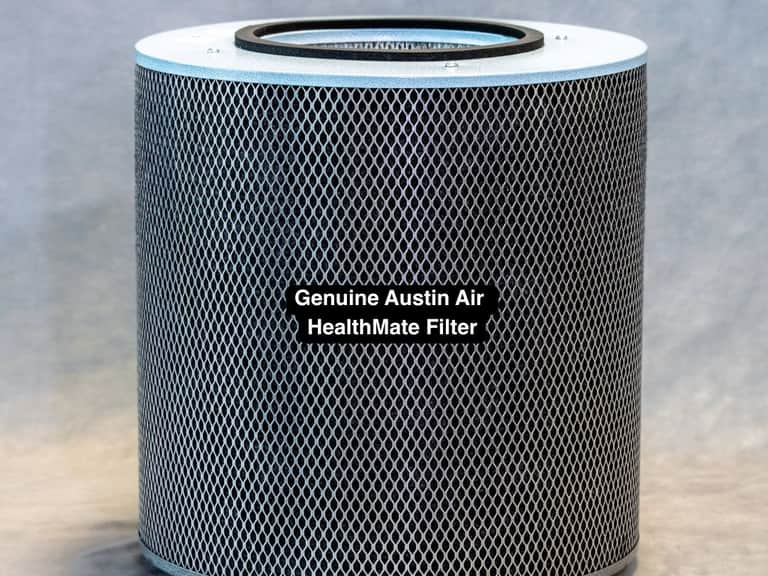
As one example of product information, the HealthMate Filter is described as a four-stage replacement filter for compatible units, with a stated life of up to five years under typical residential use. That description may help a reader understand the product’s intended role, but it is not a substitute for checking the manufacturer’s documentation, compatibility, operating conditions, and the meaning of the individual performance claims. A replacement filter is only useful in the purifier model for which it is designed, and replacement intervals should be assessed in light of actual use and instructions.
Nor does filtration eliminate the need to address a pollution source. Ventilation, source control, and appropriate maintenance can matter as much as adding a device. If a room smells strongly of a solvent, for example, the first question is not whether an air cleaner has an impressive label; it is whether the source can be removed or safely controlled. A purifier is one tool, not a substitute for every other measure.
How to read an air-purifier label without being led by it
The quickest way through a crowded product page is to translate each claim into a question. “Ionizing” becomes: what technology is used, and what measured result does it deliver? “HEPA” becomes: which standard or test supports this wording, and is the claim for the filter or the whole appliance? “Covers 1,000 square feet” becomes: at what air-change rate and fan setting? “Removes odors” becomes: which gases or odor sources were tested, and with what media?
- Find the specific performance data. Look for particle-removal efficiency, CADR, or another clearly described test result, rather than relying on a list of pollutants the product is said to address.
- Check the test conditions. Particle size, airflow, room volume, fan speed, and laboratory method can change what a headline number means.
- Separate capture from removal. Determine whether pollutants are retained in a filter, collected on a surface, transformed, or merely described as reduced.
- Look up ozone information. For ionizers and other electrical technologies, seek a measured emissions result or relevant certification, not only a general reassurance.
- Match capacity to the actual room. Account for ceiling height, open-plan layouts, pollution sources, and the fan setting you can tolerate.
- Read the maintenance details. Find filter compatibility, replacement guidance, availability, and any cleaning requirements. A long advertised filter life is not a reason to ignore inspection or care instructions.
- Notice what is missing. If a page gives broad claims but no test method, no emissions data, or no clear model-specific documentation, treat the unreported information as unknown.
It is also sensible to distinguish an independent certification from a manufacturer’s own description. A certification may apply to a particular performance measure, component, or operating condition; it does not necessarily validate every claim printed nearby. Read what the seal or listing covers. A recognizable emblem is not a universal endorsement of a device’s health claims.
Choosing by problem, not by adjective
Start with the pollutant of concern. If the issue is seasonal pollen or ordinary household dust, particle capture and adequate airflow are central. If it is smoke, both particle filtration and the circumstances producing the smoke may matter. If the concern is a gas or odor, seek information about the relevant sorbent media and tested compounds. If the priority is reducing an allergen load in a bedroom, consider the room’s size, the purifier’s sound at a usable setting, and whether the filter is maintained as directed.
Then consider the household. Someone who sleeps lightly may value quiet operation more than a headline coverage figure that applies only at maximum fan speed. A small apartment may call for a compact unit but still require attention to the volume of air in an open-plan space. A device intended for a child’s room should be assessed with the same care as any other appliance: emissions information, stability, noise, maintenance, and the manufacturer’s usage guidance all matter.
Finally, be cautious about medical language. An air cleaner may reduce certain airborne particles under specified conditions; that is not the same as preventing, diagnosing, or treating disease. Claims about asthma, infection, or other health outcomes require a different kind of evidence from a filter efficiency test. If a product makes sweeping health promises without explaining the supporting evidence, the wording is doing more work than the data.
A small glossary of claims
- Ionizer: A device or feature that electrically charges particles. The term alone does not quantify capture or room-cleaning performance.
- HEPA: A high-efficiency particulate filter designation. Check the applicable standard, test, and whether the statement concerns the filter or complete unit.
- CADR: Clean air delivery rate, a measure used to compare delivery of cleaned air for specified particle categories under defined conditions.
- Ozone emissions: Ozone produced or released during operation. Seek model-specific measurements or applicable certification information.
- Activated carbon: A porous sorbent used to capture some gases and odors. Its performance depends on the media, amount, pollutant, and operating conditions.
The quiet virtue of a measurable claim
There is no need to regard ionization as a magic word or a forbidden one. It is a technology, and technologies are best judged by their documented performance, limitations, and safety information. HEPA language can be useful, too, provided it is precise and not asked to stand in for the performance of an entire appliance. The crucial distinction is between a description of a method and evidence of an outcome.
When comparing air cleaners, the label should let you trace a straight line from the pollutant to the mechanism, from the mechanism to a test, and from the test to the room where the machine will run. If that line disappears into phrases like “pure air,” “total protection,” or “next-generation ion science,” pause. A credible specification does not need to promise everything. It needs to say what was measured, what remains uncertain, and how the equipment should be used.
That is a less theatrical standard than the packaging usually prefers. It is also the more useful one. A filter rating, room-size recommendation, and ozone-emissions result each answer a different question. Read together, they offer something better than a miracle claim: a reasonable basis for deciding whether a particular air cleaner fits a particular room and a particular need.